
Volume 2 (2018)
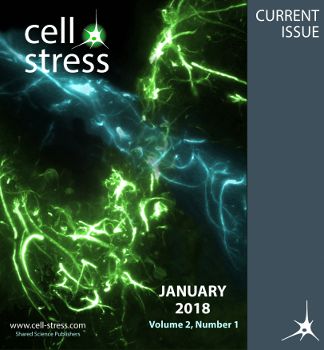
Cover: This month in Cell Stress: Kinase signaling in the innate immune system. Fluorescence microscopic depiction of immune cell responses within the CNS upon chronic pain. Images by Centre for Nanoscale BioPhotonics (CNBP) licensed under the CC BY 2.0 license. Image modified by Cell Stress. The cover is published under the CC BY 4.0 license.
SKP2 and OTUD1 govern non-proteolytic ubiquitination of YAP that promotes YAP nuclear localization and activity
Fan Yao1, Zhenna Xiao1,2, Yutong Sun3 and Li Ma1,2
YAP and its paralog TAZ are key effectors of the evolutionarily conserved Hippo signaling pathway, a pathway that regulates organ size, tissue homeostasis, and tumorigenesis. In human cells, MST1/2 (mammalian
T lymphocytes against solid malignancies: winning ways to defeat tumours
Ignazio Caruana1,§, Luca Simula1,2,§, Franco Locatelli1,# and Silvia Campello2,3, #
INTRODUCTION When a tumour mass starts growing in the body, T lymphocytes are activated inside secondary lymphoid organs (SLOs) and mount an immune response against immuno-stimulating tumour antigens presented by
GFI1’s role in DNA repair suggests implications for tumour cell response to treatment
Charles Vadnais1 and Tarik Möröy1,2,3
GFI1 was discovered over 20 years ago and a large body of experimental evidence defines its function as a DNA binding transcriptional repressor. Since GFI1 does not possess any enzymatic
Mitochondrial dysfunction and its role in tissue-specific cellular stress
David Pacheu-Grau1, Robert Rucktäschel1 and Markus Deckers1
Mitochondrial bioenergetics require the coordination of two different and independent genomes. Mutations in either genome will affect mitochondrial functionality and produce different sources of cellular stress. Depending on the kind of defect and stress, different tissues and organs will be affected, leading to diverse pathological conditions. There is no curative therapy for mitochondrial diseases, nevertheless, there are strategies described that fight the various stress forms caused by the malfunctioning organelles. Here, we will revise the main kinds of stress generated by mutations in mitochondrial genes and outline several ways of fighting this stress.
Alzheimer’s disease: amyloid-based pathogenesis and potential therapies
Yixiu Zhou1, Yuhui Sun2, Quan-Hong Ma2 and Yaobo Liu2
INTRODUCTION Alzheimer’s disease (AD) is one of the most prevalent forms of dementia; in 2015, for example, AD affected ~46.8 million people worldwide. It is estimated that this number will
Amelioration of obesity-induced diabetes by a novel autophagy enhancer
Hyejin Lim1 and Myung-Shik Lee1
Our screening system was a convenient high throughput assay of autophagic flux rather than cumulative autophagy levels, and the index of autophagic activity was calculated as the ratio of the
SKP2 and OTUD1 govern non-proteolytic ubiquitination of YAP that promotes YAP nuclear localization and activity
Fan Yao1, Zhenna Xiao1,2, Yutong Sun3 and Li Ma1,2
YAP and its paralog TAZ are key effectors of the evolutionarily conserved Hippo signaling pathway, a pathway that regulates organ size, tissue homeostasis, and tumorigenesis. In human cells, MST1/2 (mammalian
T lymphocytes against solid malignancies: winning ways to defeat tumours
Ignazio Caruana1,§, Luca Simula1,2,§, Franco Locatelli1,# and Silvia Campello2,3, #
INTRODUCTION When a tumour mass starts growing in the body, T lymphocytes are activated inside secondary lymphoid organs (SLOs) and mount an immune response against immuno-stimulating tumour antigens presented by
GFI1’s role in DNA repair suggests implications for tumour cell response to treatment
Charles Vadnais1 and Tarik Möröy1,2,3
GFI1 was discovered over 20 years ago and a large body of experimental evidence defines its function as a DNA binding transcriptional repressor. Since GFI1 does not possess any enzymatic
Mitochondrial dysfunction and its role in tissue-specific cellular stress
David Pacheu-Grau1, Robert Rucktäschel1 and Markus Deckers1
Mitochondrial bioenergetics require the coordination of two different and independent genomes. Mutations in either genome will affect mitochondrial functionality and produce different sources of cellular stress. Depending on the kind of defect and stress, different tissues and organs will be affected, leading to diverse pathological conditions. There is no curative therapy for mitochondrial diseases, nevertheless, there are strategies described that fight the various stress forms caused by the malfunctioning organelles. Here, we will revise the main kinds of stress generated by mutations in mitochondrial genes and outline several ways of fighting this stress.
Alzheimer’s disease: amyloid-based pathogenesis and potential therapies
Yixiu Zhou1, Yuhui Sun2, Quan-Hong Ma2 and Yaobo Liu2
INTRODUCTION Alzheimer’s disease (AD) is one of the most prevalent forms of dementia; in 2015, for example, AD affected ~46.8 million people worldwide. It is estimated that this number will
Endolysosomal dysfunction and exosome secretion: implications for neurodegenerative disorders
André M. Miranda1,2,3,4 and Gilbert Di Paolo1,2,5
A master regulator of both endolysosomal function and autophagy is Vps34 and its lipid product phosphatidylinositol-3-phosphate (PI3P) through which the lipid kinase exerts most of its biological actions in eukaryotic
Putting together and taking apart: assembly and disassembly of the Rad51 nucleoprotein filament in DNA repair and genome stability
Tadas Andriuskevicius1, Oleksii Kotenko1 and Svetlana Makovets1
Homologous recombination is a key mechanism providing both genome stability and genetic diversity in all living organisms. Recombinases play a central role in this pathway: multiple protein subunits of Rad51 or its orthologues bind single-stranded DNA to form a nucleoprotein filament which is essential for initiating recombination events. Multiple factors are involved in the regulation of this step, both positively and negatively. In this review, we discuss Rad51 nucleoprotein assembly and disassembly, how it is regulated and what functional significance it has in genome maintenance.
Oxidation of p62 as an evolutionary adaptation to promote autophagy in stress conditions
Elsje G. Otten1,§, Rhoda Stefanatos1, Bernadette Carroll1, Viktor I. Korolchuk1
Autophagy (literally meaning self-eating) is an intracellular trafficking pathway. It involves the formation of a double membraned organelle (called the autophagosome) around components of the cell, such as damaged proteins,
How to use a multipurpose SNARE: The emerging role of Snap29 in cellular health
Valeria Mastrodonato1,#, Elena Morelli1,# and Thomas Vaccari1
[table id=90 /] INTRODUCTION The specialized trafficking routes that evolved between compartments of the endomembrane system rely on a wide set of proteins, including primarily SNAREs, Rab GTPases and a
Therapeutic potential of DNA methyltransferase inhibitors with immune checkpoint inhibitor therapy in breast cancer
Na Luo1, Ayaka Sugiura2 and Justin M. Balko1,3,4,5
Tumor infiltrating lymphocytes (TILs) are a positive prognostic biomarker in breast cancer, particularly in hormone receptor-negative disease. High TILs associate with an improved survival rate in breast cancer patients, and
The emerging role of minor intron splicing in neurological disorders
Daniel Jutzi 1,2,+, Maureen V. Akinyi 3,+, Jonas Mechtersheimer1,2,+, Mikko J. Frilander3 and Marc-David Ruepp1,4
INTRODUCTION Pre-mRNA splicing is an essential step in eukaryotic gene expression. It is predominantly a co-transcriptional process during which the non-coding introns are excised from precursor mRNA (pre-mRNA) molecules and
A new way to regulate inflammation: selective autophagic degradation of IKKγ mediated by ANGPTL8
Yu Zhang1, Ling Zheng2 and Kun Huang1
Activation of transcription factor nuclear factor-κB (NF-κB) is one of the central events in inflammation and immunity. In resting cells, the activity of NF-κB is inhibited by its binding partner,
Rejuvenation of the aged neuromuscular junction by exercise
Tabita Kreko-Pierce1,2 and Benjamin A. Eaton1,2
Age-dependent declines in muscle function are observed across species. The loss of mobility resulting from the decline in muscle function represents an important health issue and a key determinant of quality of life for the elderly. It is believed that changes in the structure and function of the neuromuscular junction are important contributors to the observed declines in motor function with increased age. Numerous studies indicate that the aging muscle is an important contributor to the deterioration of the neuromuscular junction but the cellular and molecular mechanisms driving the degeneration of the synapse remain incompletely described. Importantly, growing data from both animal models and humans indicate that exercise can rejuvenate the neuromuscular junction and improve motor function. In this review we will focus on the role of muscle-derived neurotrophin signaling in the rejuvenation of the aged neuromuscular junction in response to exercise.
Base editors: a powerful tool for generating animal models of human diseases
Zongyang Lu1,2 and Xingxu Huang1,3
BASE EDITORS: A NOVEL GENOME ENGINEERING TOOL Genetically engineered mouse models of human diseases have long been used in understanding the underlying mechanisms of the clinically relevant genetic disorders. In
Unweaving the role of nuclear Lamins in neural circuit integrity
Samantha L. Deal1 and Shinya Yamamoto1,2,3,4
Structural integrity of the nuclear membrane is essential for the homeostasis of eukaryotic cells. Critical components of this process are Lamins or type-V intermediate filament proteins that form a meshwork
Alzheimer’s disease: amyloid-based pathogenesis and potential therapies
Yixiu Zhou1, Yuhui Sun2, Quan-Hong Ma2 and Yaobo Liu2
INTRODUCTION Alzheimer’s disease (AD) is one of the most prevalent forms of dementia; in 2015, for example, AD affected ~46.8 million people worldwide. It is estimated that this number will
Membrane closure in stress induced-autophagosome formation
Eiji Morita1
Autophagy (macroautophagy) is a bulk degradation system that sequesters cytoplasmic components by generating double-layered isolation membranes and delivering these isolated contents to the lysosomes [cite]10.1146/annurev-cellbio-092910-154005[/cite]. Though this pathway was originally
Centriolar satellites prevent uncontrolled degradation of centrosome proteins: a speculative review
Nicolas Lecland1 and Andreas Merdes1
INTRODUCTION Centrosomes are cytoplasmic structures that serve as primary microtubule organizing centers in a large variety of animal cells. They consist of a pair of cylindrically shaped centrioles, surrounded by
Novel role of the SIRT4-OPA1 axis in mitochondrial quality control
Alexander Lang1 and Roland P. Piekorz1
Aging is defined by various molecular and cellular hallmarks, among them stem cell exhaustion, genomic instability, altered proteostasis, cellular senescence, and mitochondrial dysfunction [cite]10.1016/j.cell.2013.05.039[/cite]. Mitochondrial defects are considered major drivers