
Volume 2 (2018)
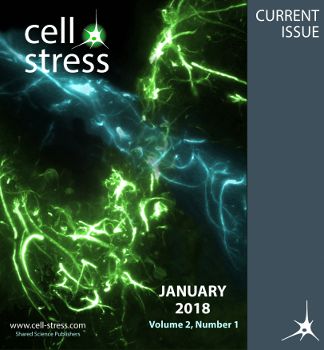
Cover: This month in Cell Stress: Kinase signaling in the innate immune system. Fluorescence microscopic depiction of immune cell responses within the CNS upon chronic pain. Images by Centre for Nanoscale BioPhotonics (CNBP) licensed under the CC BY 2.0 license. Image modified by Cell Stress. The cover is published under the CC BY 4.0 license.
Oxidation of p62 as an evolutionary adaptation to promote autophagy in stress conditions
Elsje G. Otten1,§, Rhoda Stefanatos1, Bernadette Carroll1, Viktor I. Korolchuk1
Autophagy (literally meaning self-eating) is an intracellular trafficking pathway. It involves the formation of a double membraned organelle (called the autophagosome) around components of the cell, such as damaged proteins,
How to use a multipurpose SNARE: The emerging role of Snap29 in cellular health
Valeria Mastrodonato1,#, Elena Morelli1,# and Thomas Vaccari1
[table id=90 /] INTRODUCTION The specialized trafficking routes that evolved between compartments of the endomembrane system rely on a wide set of proteins, including primarily SNAREs, Rab GTPases and a
Assay for high-throughput screening of inhibitors of the ASC-PYD inflammasome core filament
Lorenzo Sborgi1, Johanna Ude1, Mathias S. Dick1, Jonathan Vesin2, Marc Chambon2, Gerardo Turcatti2, Petr Broz1, Sebastian Hiller1
The protein ASC is a central component of most inflammasome complexes, forming functional oligomeric filaments that activate large amounts of pro-caspase-1 for further IL-1β processing and the induction of Gasdermin D-dependent cell death. The central role of inflammasomes in the innate immune response pose them as new molecular targets for therapy of diverse acute, chronic and inherited autoinflammatory pathologies. In recent years, an increasing number of molecules were proposed to modulate inflammasome signalling by interacting with different components of inflammasome complexes. However, the difficult in vitro reconstitution of the inflammasome has limited the development of specific on-target biochemical assays for compound activity confirmation and for drug discovery in high throughput screening setups. Here we describe a homogeneous, pH (...)
Dram1 regulates DNA damage-induced alternative autophagy
Meruna Nagata1, Satoko Arakawa1, Hirofumi Yamaguchi1, Satoru Torii1, Hazuki Endo1, Masatsune Tsujioka1, Shinya Honda1, Yuya Nishida1, Akimitsu Konishi1,2, Shigeomi Shimizu1
Autophagy is an evolutionarily conserved process that degrades subcellular constituents. Mammalian cells undergo two types of autophagy; Atg5-dependent conventional autophagy and Atg5-independent alternative autophagy, and the molecules required for the latter type of autophagy are largely unknown. In this study, we analyzed the molecular mechanisms of genotoxic stress-induced alternative autophagy, and identified the essential role of p53 and damage-regulated autophagy modulator (Dram1). Dram1 was sufficient to induce alternative autophagy. In the mechanism of alternative autophagy, Dram1 functions in the closure of isolation membranes downstream of p53. These findings indicate that Dram1 plays a pivotal role in genotoxic stress-induced alternative autophagy.
Therapeutic potential of DNA methyltransferase inhibitors with immune checkpoint inhibitor therapy in breast cancer
Na Luo1, Ayaka Sugiura2 and Justin M. Balko1,3,4,5
Tumor infiltrating lymphocytes (TILs) are a positive prognostic biomarker in breast cancer, particularly in hormone receptor-negative disease. High TILs associate with an improved survival rate in breast cancer patients, and
The emerging role of minor intron splicing in neurological disorders
Daniel Jutzi 1,2,+, Maureen V. Akinyi 3,+, Jonas Mechtersheimer1,2,+, Mikko J. Frilander3 and Marc-David Ruepp1,4
INTRODUCTION Pre-mRNA splicing is an essential step in eukaryotic gene expression. It is predominantly a co-transcriptional process during which the non-coding introns are excised from precursor mRNA (pre-mRNA) molecules and
A new way to regulate inflammation: selective autophagic degradation of IKKγ mediated by ANGPTL8
Yu Zhang1, Ling Zheng2 and Kun Huang1
Activation of transcription factor nuclear factor-κB (NF-κB) is one of the central events in inflammation and immunity. In resting cells, the activity of NF-κB is inhibited by its binding partner,
Rejuvenation of the aged neuromuscular junction by exercise
Tabita Kreko-Pierce1,2 and Benjamin A. Eaton1,2
Age-dependent declines in muscle function are observed across species. The loss of mobility resulting from the decline in muscle function represents an important health issue and a key determinant of quality of life for the elderly. It is believed that changes in the structure and function of the neuromuscular junction are important contributors to the observed declines in motor function with increased age. Numerous studies indicate that the aging muscle is an important contributor to the deterioration of the neuromuscular junction but the cellular and molecular mechanisms driving the degeneration of the synapse remain incompletely described. Importantly, growing data from both animal models and humans indicate that exercise can rejuvenate the neuromuscular junction and improve motor function. In this review we will focus on the role of muscle-derived neurotrophin signaling in the rejuvenation of the aged neuromuscular junction in response to exercise.
Novel role of the SIRT4-OPA1 axis in mitochondrial quality control
Alexander Lang1 and Roland P. Piekorz1
Aging is defined by various molecular and cellular hallmarks, among them stem cell exhaustion, genomic instability, altered proteostasis, cellular senescence, and mitochondrial dysfunction [cite]10.1016/j.cell.2013.05.039[/cite]. Mitochondrial defects are considered major drivers
Therapeutic potential of HDAC6 in amyotrophic lateral sclerosis
Wenting Guo1,2 and Ludo Van Den Bosch1,2
Amyotrophic lateral sclerosis (ALS) is a neurodegenerative disorder characterized by the selective death of motor neurons in the motor cortex, brainstem and spinal cord. This leads to progressive muscle weakness,
Targeting Nfix to fix muscular dystrophies
Giuliana Rossi1, Valentina Taglietti2 and Graziella Messina2
A shared knowledge in the field is that to be really successful, any therapeutic strategy has to rely on good muscle quality. In fact, there is no available approach able
Salmonella Typhimurium infection: Type I Interferons integrate cellular networks to disintegrate macrophages
Nirmal Robinson1,2
Salmonella enterica serovar Typhimurium (S. Typhimurium) are facultative intracellular bacteria that effectively evade innate immune defense mechanisms using a plethora of pathogenic principles encoded in their pathogenicity islands namely Salmonella
miR34a: a master regulator in the pathogenesis of bronchopulmonary dysplasia
Pragnya Das1, Mansoor Ali Syed1,2, Dilip Shah1, Vineet Bhandari1,3,*
BPD has been getting more attention as neonatologists from across the world are getting better in saving the lives of premature neonates. This has mobilized intense research to fill the
Therapeutic potential of HDAC6 in amyotrophic lateral sclerosis
Wenting Guo1,2 and Ludo Van Den Bosch1,2
Amyotrophic lateral sclerosis (ALS) is a neurodegenerative disorder characterized by the selective death of motor neurons in the motor cortex, brainstem and spinal cord. This leads to progressive muscle weakness,
Targeting Nfix to fix muscular dystrophies
Giuliana Rossi1, Valentina Taglietti2 and Graziella Messina2
A shared knowledge in the field is that to be really successful, any therapeutic strategy has to rely on good muscle quality. In fact, there is no available approach able
Base editors: a powerful tool for generating animal models of human diseases
Zongyang Lu1,2 and Xingxu Huang1,3
BASE EDITORS: A NOVEL GENOME ENGINEERING TOOL Genetically engineered mouse models of human diseases have long been used in understanding the underlying mechanisms of the clinically relevant genetic disorders. In
Unweaving the role of nuclear Lamins in neural circuit integrity
Samantha L. Deal1 and Shinya Yamamoto1,2,3,4
Structural integrity of the nuclear membrane is essential for the homeostasis of eukaryotic cells. Critical components of this process are Lamins or type-V intermediate filament proteins that form a meshwork
Alzheimer’s disease: amyloid-based pathogenesis and potential therapies
Yixiu Zhou1, Yuhui Sun2, Quan-Hong Ma2 and Yaobo Liu2
INTRODUCTION Alzheimer’s disease (AD) is one of the most prevalent forms of dementia; in 2015, for example, AD affected ~46.8 million people worldwide. It is estimated that this number will
Membrane closure in stress induced-autophagosome formation
Eiji Morita1
Autophagy (macroautophagy) is a bulk degradation system that sequesters cytoplasmic components by generating double-layered isolation membranes and delivering these isolated contents to the lysosomes [cite]10.1146/annurev-cellbio-092910-154005[/cite]. Though this pathway was originally
Centriolar satellites prevent uncontrolled degradation of centrosome proteins: a speculative review
Nicolas Lecland1 and Andreas Merdes1
INTRODUCTION Centrosomes are cytoplasmic structures that serve as primary microtubule organizing centers in a large variety of animal cells. They consist of a pair of cylindrically shaped centrioles, surrounded by
Novel role of the SIRT4-OPA1 axis in mitochondrial quality control
Alexander Lang1 and Roland P. Piekorz1
Aging is defined by various molecular and cellular hallmarks, among them stem cell exhaustion, genomic instability, altered proteostasis, cellular senescence, and mitochondrial dysfunction [cite]10.1016/j.cell.2013.05.039[/cite]. Mitochondrial defects are considered major drivers