
Volume 2 (2018)
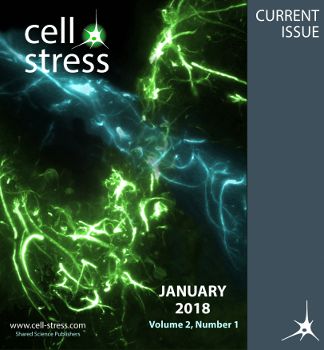
Cover: This month in Cell Stress: Kinase signaling in the innate immune system. Fluorescence microscopic depiction of immune cell responses within the CNS upon chronic pain. Images by Centre for Nanoscale BioPhotonics (CNBP) licensed under the CC BY 2.0 license. Image modified by Cell Stress. The cover is published under the CC BY 4.0 license.
Salmonella Typhimurium infection: Type I Interferons integrate cellular networks to disintegrate macrophages
Nirmal Robinson1,2
Salmonella enterica serovar Typhimurium (S. Typhimurium) are facultative intracellular bacteria that effectively evade innate immune defense mechanisms using a plethora of pathogenic principles encoded in their pathogenicity islands namely Salmonella
Centriolar satellites prevent uncontrolled degradation of centrosome proteins: a speculative review
Nicolas Lecland1 and Andreas Merdes1
INTRODUCTION Centrosomes are cytoplasmic structures that serve as primary microtubule organizing centers in a large variety of animal cells. They consist of a pair of cylindrically shaped centrioles, surrounded by
miR34a: a master regulator in the pathogenesis of bronchopulmonary dysplasia
Pragnya Das1, Mansoor Ali Syed1,2, Dilip Shah1, Vineet Bhandari1,3,*
BPD has been getting more attention as neonatologists from across the world are getting better in saving the lives of premature neonates. This has mobilized intense research to fill the
Novel role of the SIRT4-OPA1 axis in mitochondrial quality control
Alexander Lang1 and Roland P. Piekorz1
Aging is defined by various molecular and cellular hallmarks, among them stem cell exhaustion, genomic instability, altered proteostasis, cellular senescence, and mitochondrial dysfunction [cite]10.1016/j.cell.2013.05.039[/cite]. Mitochondrial defects are considered major drivers
Therapeutic potential of HDAC6 in amyotrophic lateral sclerosis
Wenting Guo1,2 and Ludo Van Den Bosch1,2
Amyotrophic lateral sclerosis (ALS) is a neurodegenerative disorder characterized by the selective death of motor neurons in the motor cortex, brainstem and spinal cord. This leads to progressive muscle weakness,
Targeting Nfix to fix muscular dystrophies
Giuliana Rossi1, Valentina Taglietti2 and Graziella Messina2
A shared knowledge in the field is that to be really successful, any therapeutic strategy has to rely on good muscle quality. In fact, there is no available approach able
p53 and energy balance: meeting hypothalamic AgRP neurons
Omar Al-Massadi1,2,#, Mar Quiñones1,2,#, Ruben Nogueiras1,2
Cancer cells undergo profound metabolic changes to cope with the high energy demand for cell growth and division. Given the importance of this metabolic reprogramming in tumor development, it seems
Mitochondrial stress management: a dynamic journey
Miriam Valera-Alberni1,2 and Carles Canto1
Mitochondria undergo continuous challenges in the course of their life, from their generation to their degradation. These challenges include the management of reactive oxygen species, the proper assembly of mitochondrial respiratory complexes and the need to balance potential mutations in the mitochondrial DNA. The detection of damage and the ability to keep it under control is critical to fine-tune mitochondrial function to the organismal energy needs. In this review, we will analyze the multiple mechanisms that safeguard mitochondrial function in light of in crescendo damage. This sequence of events will include initial defense against excessive reactive oxygen species production, compensation mechanisms by the unfolded protein response (UPRmt), mitochondrial dynamics and elimination by mitophagy.
Therapeutic anti-tumor immunity directed against neo-epitopes by intratumor delivery of mRNA encoding MLKL
Lien Van Hoecke1,2 and Xavier Saelens1,2,3
We have developed a potentially generic treatment method to induce tumor antigen-specific cellular immunity based on the transient intra-tumor expression of the necroptosis-inducing factor MLKL (Figure 1). Importantly, we have
Amelioration of obesity-induced diabetes by a novel autophagy enhancer
Hyejin Lim1 and Myung-Shik Lee1
Our screening system was a convenient high throughput assay of autophagic flux rather than cumulative autophagy levels, and the index of autophagic activity was calculated as the ratio of the
Striatal dual cholinergic /GABAergic transmission in Parkinson disease: friends or foes?
Natalia Lozovaya1, Yehezkel Ben-Ari1 and Constance Hammond1
Although constituting less than 1% of neuronal population of the striatum, cholinergic interneurons play a major role in the control of sensory integration in preparation for movements. These giant neurons
The NLRC4 inflammasome requires IRF8-dependent production of NAIPs
Ein Lee1,2, Rajendra Karki1 and Thirumala-Devi Kanneganti1
Inflammasomes orchestrate cellular responses to pathogen- or danger-associated molecular patterns by controlling the activation of caspase-1. Inflammasome activation results in enzymatically active caspase-1, which mediates the maturation and release of
Targeting LRH-1/NR5A2 to treat type 1 diabetes mellitus
Nadia Cobo-Vuilleumier1, Petra I. Lorenzo1 and Benoit R. Gauthier1
The liver receptor homolog-1 (LRH-1) is a member of the NR5A family of nuclear receptors that plays a pivotal role in early embryonic development while later on it specifies the
Nucleolar Stress: hallmarks, sensing mechanism and diseases
Kai Yang1,2, Jie Yang1 and Jing Yi1
The nucleolus is a prominent subnuclear compartment, where ribosome biosynthesis takes place. Recently, the nucleolus has gained attention for its novel role in the regulation of cellular stress. Nucleolar stress is emerging as a new concept, which is characterized by diverse cellular insult-induced abnormalities in nucleolar structure and function, ultimately leading to activation of p53 or other stress signaling pathways and alterations in cell behavior. Despite a number of comprehensive reviews on this concept, straightforward and clear-cut way criteria for a nucleolar stress state, regarding the factors that elicit this state, the morphological and functional alterations as well as the rationale for p53 activation are still missing. Based on literature of the past two decades, we herein summarize the evolution of the concept and provide hallmarks of nucleolar stress. Along with updated information and thorough discussion of existing confusions in the field, we pay particular attention to the current understanding of the sensing mechanisms (...)
Calling RNF168 to action
Somaira Nowsheen1 and Zhenkun Lou2
– [table id=103 /] – It is interesting to note that MDC1 acts as a node for the recruitment of both RNF8 and L3MBTL2 and brings these two factors into
Exosomal secretion of truncated cytosolic lysyl-tRNA synthetase induces inflammation during cell starvation
Sang Bum Kim1,2, Seongmin Cho1, 2 and Sunghoon Kim1,2
Kim et al. (2017) reveals three crucial steps of KRS secretion, including its dissociation from the MSC complex, interaction with syntenin, and secretion via the exosomal pathway (Figure 1). –
Base editors: a powerful tool for generating animal models of human diseases
Zongyang Lu1,2 and Xingxu Huang1,3
BASE EDITORS: A NOVEL GENOME ENGINEERING TOOL Genetically engineered mouse models of human diseases have long been used in understanding the underlying mechanisms of the clinically relevant genetic disorders. In
Unweaving the role of nuclear Lamins in neural circuit integrity
Samantha L. Deal1 and Shinya Yamamoto1,2,3,4
Structural integrity of the nuclear membrane is essential for the homeostasis of eukaryotic cells. Critical components of this process are Lamins or type-V intermediate filament proteins that form a meshwork
Alzheimer’s disease: amyloid-based pathogenesis and potential therapies
Yixiu Zhou1, Yuhui Sun2, Quan-Hong Ma2 and Yaobo Liu2
INTRODUCTION Alzheimer’s disease (AD) is one of the most prevalent forms of dementia; in 2015, for example, AD affected ~46.8 million people worldwide. It is estimated that this number will
Membrane closure in stress induced-autophagosome formation
Eiji Morita1
Autophagy (macroautophagy) is a bulk degradation system that sequesters cytoplasmic components by generating double-layered isolation membranes and delivering these isolated contents to the lysosomes [cite]10.1146/annurev-cellbio-092910-154005[/cite]. Though this pathway was originally
Centriolar satellites prevent uncontrolled degradation of centrosome proteins: a speculative review
Nicolas Lecland1 and Andreas Merdes1
INTRODUCTION Centrosomes are cytoplasmic structures that serve as primary microtubule organizing centers in a large variety of animal cells. They consist of a pair of cylindrically shaped centrioles, surrounded by
Novel role of the SIRT4-OPA1 axis in mitochondrial quality control
Alexander Lang1 and Roland P. Piekorz1
Aging is defined by various molecular and cellular hallmarks, among them stem cell exhaustion, genomic instability, altered proteostasis, cellular senescence, and mitochondrial dysfunction [cite]10.1016/j.cell.2013.05.039[/cite]. Mitochondrial defects are considered major drivers